


On October 25, 2019 the “potentially hazardous” asteroid 162082 (1998 HL1) made its closest approach to earth. The asteroid has a diameter of a little over 500 meters and was still more than 6 million kilometers away, which corresponds to 10 earth-moon distances – not so close after all. Nevertheless, […]
Robert Roth
49 posts
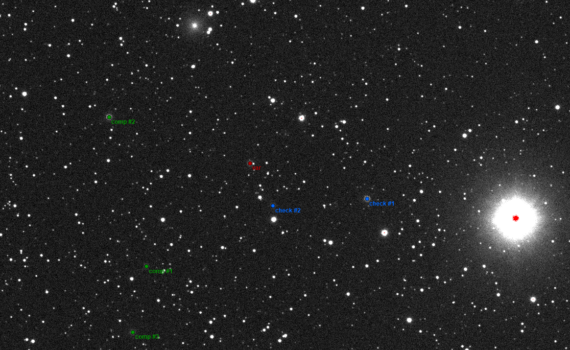
Gerrit Leck & Jan Kuske On November 18th 2019 we were the first group of students to conduct the new FP-experiment “Photometry in Astrophysics”. We observed several variable stars and exoplanet transits using differential photometry. Here we present extracts of our results. In the night from 23rd to 24th November […]
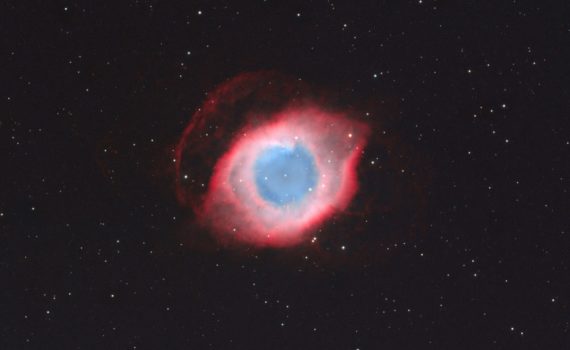
The Helix Nebula, NGC7293, is one of the largest and brightest planetary nebulae in the sky – only 650 light years from earth in the constellation Aquarius. For the expansion velocity one ca estimate that the Helix Nebula was born 10000 years ago. It was formed by a low-mass star, […]
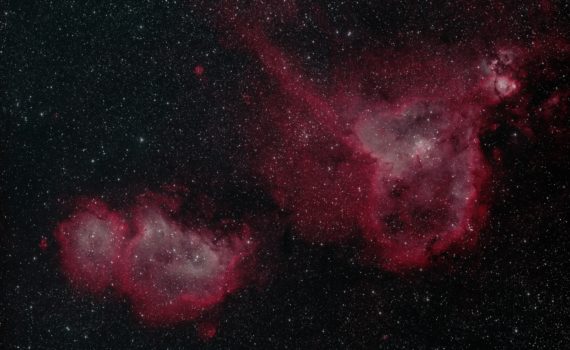
Time for another wide-field image using the Samyang telephoto lens that rides piggy-back on the main scope at our TURMX setup. This is the heart and soul nebula, IC1805 and IC1848, in the constellation Cassiopeia. They are part of a vast star-forming complex about 6000 light years away in the […]
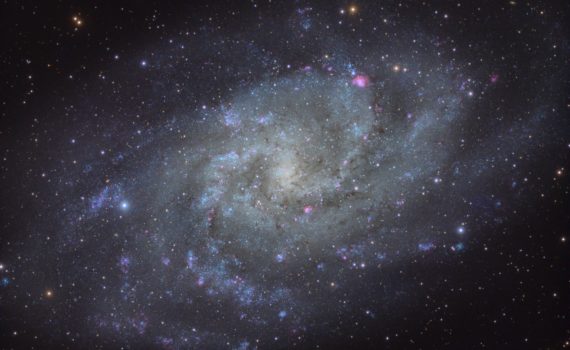
We shot Triangulum Galaxy (M33) already as one of the first-light targets at the TURMX setup. Well, this beautiful spiral galaxy deserves a little more attention, so we added a couple of hours of extra exposure time and reprocessed the combined data set. With more than double the exposure time, […]

The Heart Nebula (IC1805, Sh2-190) is an emission nebula located in the constellation Cassiopeia. It its about 7500 light years from earth in the Perseus Arm of our Milky Way galaxy. It has a diameter of about 165 light years. This image shows the hear of the Heart Nebula, the […]
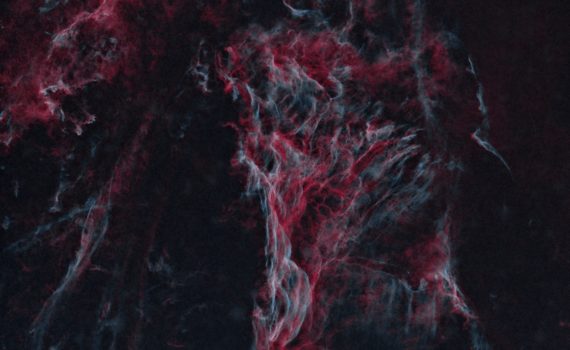
After the first-light version of Pickering’s Triangle we collected a few hours more data of this fascinating part of the Cygnus Loop. This combined set of 15 hours of H-alpha and OIII narrowband data allows to bring out all the intricate structure in this supernova remnant. To emphasize the nebulosity […]


The Pacman Nebula (NGC281, IC11, Sh2-184) is a nice combination of an emission nebula and some dust clouds. It is located in the constellation Cassiopeia at a distance of about 9000 light years. The false-color images below are composed of narrowband exposure using Ha, OIII, and SII filters. The way […]

Among the more mysterious deep-sky objects are dark nebulae – clouds of interstellar dust that do not emit light themselves, but absorb the light from background stars. Hidden the denser regions of these dust clouds new stars are formed, new stars from the ashes of previous generations. Observing them requires […]

The Andromeda Galaxy, M31, a truly magnificent sight. It is the sister of our own galaxy and the closest major galaxy with a distance of only 2.5 million light years. Our Milky Way, the Andromeda Galaxy, and the Triangulum Galaxy, M33, are members of the Local Group, which also hosts […]
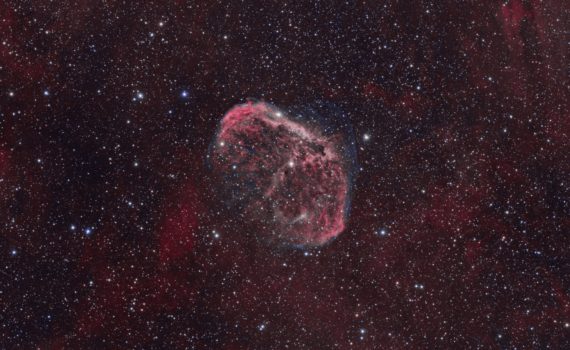
The Crescent Nebula, NGC6888, is one of the prominent emission nebulae in Cygnus, about 5000 light years away from Earth. It is associated with the Wolf-Rayet star WR136. When this star turned into a red giant about 100,000 years ago, it expelled its outer layers of gas, which slowly expanded […]

The Elephant’s Trunk is one these mysterious combinations of dark dust clouds embedded into bright emission nebulae. The elephant’s trunk itself is the dark horizontal column left of the center in the image below. It is embedded into a much larger emission nebula IC1396 in the constellation Cepheus at a […]

This is the last in our series of “first light” images taken at the TURMX observatory. All of the data for these first light images was collected in the first two or three weeks of remote operation. The object for this image is the so-called Cygnus Wall, a part of […]
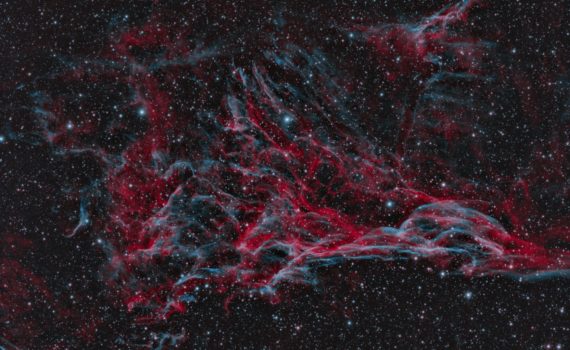
Pickering’s Triangle is named after Professor Edward Charles Pickering, director of the Harvard College Observatory. It should better be called Fleming’s Triangle, because it was discovered by Williamina Fleming as part of her work on evaluating photographic plates at Pickering’s observatory. It is a part of the Cygnus Loop or […]